Police Cruiser Crashes While Transporting Suspect to Jail, Sending Him Through Rear Window Before He Flees
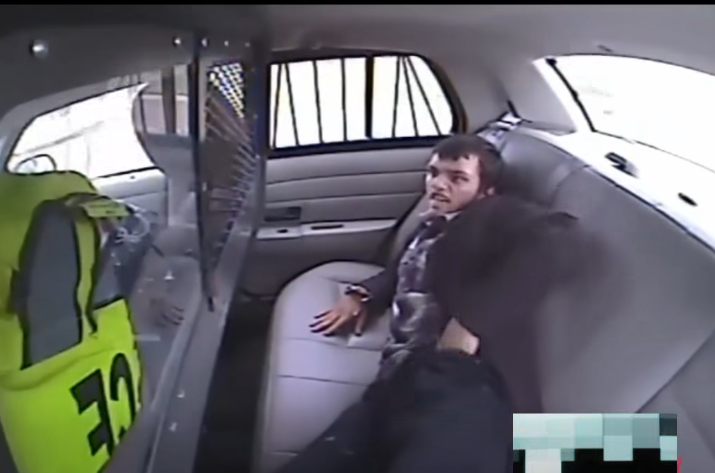
A police transport in Jonesboro, Arkansas, took a dramatic and unexpected turn when a patrol vehicle carrying an officer and a 19-year-old suspect crashed, sending the young man through the rear windshield. The incident, which occurred on a Thursday evening, was captured by a camera inside the police vehicle. Officer Justin Thompson was transporting Logan Younger to jail when the crash happened. Thompson was injured and transported to a hospital in Memphis, Tennessee, where he received treatment before being released. Younger, meanwhile, was thrown from the vehicle during the collision and reportedly fled the scene before officers located and apprehended him a short time later. The unusual sequence raised serious questions about the circumstances of the crash, the safety of prisoner transportation, and how the suspect was able to leave the scene after such a forceful impact. Authorities confirmed that the cause of the wreck remained under investigation.
The incident began as Officer Justin Thompson was carrying out a law enforcement transport involving 19-year-old Logan Younger.
According to the Jonesboro Police Department, Younger was seated in the back of the patrol vehicle while Thompson was taking him to jail.
Transporting someone in custody is a routine responsibility for law enforcement officers, but it requires particular attention to safety.
Unlike an ordinary passenger, a person being transported to a detention facility is under police supervision and may have restrictions on their movement.
The officer must operate the vehicle while maintaining responsibility for the person in custody.
In this case, the transport was interrupted by a serious traffic crash.
The supplied report does not explain why Younger had originally been taken into custody or identify the charges he faced before the incident.
It also does not specify the route Thompson was traveling or the exact location where the wreck occurred.
Those details would be necessary for a complete reconstruction, but they are not included in the available account.
What is established is that Thompson was driving a police vehicle with Younger in the back seat when the crash happened.
The collision occurred on a Thursday evening.
The report does not provide the exact time or date.
During the wreck, the force of the impact caused Younger to be thrown through the vehicle’s rear windshield.
The moment was captured by an interior camera.
According to the description of the recording, Younger can be seen moving out through the back of the vehicle as the crash occurs.
The footage documented a highly unusual and dangerous event during a police transport.
A vehicle collision can generate forces strong enough to throw occupants violently from their seats.
The severity of those forces depends on factors such as vehicle speed, the direction of impact, and the use of occupant restraints.
The supplied report does not establish whether Younger was wearing a seat belt at the time of the crash.
It also does not describe the vehicle’s speed or identify what the police cruiser struck.
Those facts are important because they could help explain how the young man was ejected through the rear windshield.
However, it would be inappropriate to assume that a missing seat belt, excessive speed, or a particular driving maneuver caused the ejection without supporting evidence.
Authorities specifically stated that the cause of the crash was still being investigated.
The video provided a striking view of the incident, but it did not necessarily answer every question about why the vehicle wrecked.
Interior cameras can document the movements of occupants during a collision.
They may show how a person reacts when the vehicle suddenly changes direction or experiences an impact.
However, a camera facing the passenger compartment may not capture the road conditions, surrounding traffic, or external events that contributed to the crash.
A full investigation would therefore require evidence beyond the interior recording.
The collision also resulted in injuries to Officer Thompson.
Following the wreck, he was transported to a hospital in Memphis for medical treatment.
The decision to send him to a hospital in another city indicated that he required professional medical evaluation following the crash.
However, the supplied account does not describe the nature or severity of his injuries.
It also does not explain why that particular hospital was selected.
Without those details, it would be speculative to suggest that he suffered a specific injury or required a particular procedure.
The Jonesboro Police Department subsequently confirmed that Thompson had been released from the hospital.
That update was an encouraging development following the collision.
It established that the officer had received treatment and was no longer hospitalized at the time of the department’s statement.
The report does not provide additional information about his recovery or whether he immediately returned to duty.
Those details remain outside the available account.
While Thompson was receiving medical attention, another unexpected development occurred at the crash scene.
Despite being thrown through the rear windshield, Younger reportedly fled.
According to authorities, the 19-year-old left the area after the wreck.
The report does not explain how he was able to move away from the scene or describe his physical condition immediately after the ejection.
It also does not establish whether he sustained any injuries.
Being ejected from a vehicle can cause serious harm, but the supplied information does not provide a medical assessment of Younger.
It would therefore be inappropriate to claim that he escaped without injury or that he suffered a particular type of trauma.
The confirmed fact is that he was able to leave the scene following the crash.
His departure created an additional law enforcement concern.
Before the collision, Younger had been in police custody and was being transported to jail.
After the wreck, he was no longer under the immediate control of the transporting officer.
Authorities then had to locate him.
The supplied account does not describe the methods officers used to search for Younger or indicate how far he traveled from the crash scene.
It also does not identify whether he received assistance from anyone else.
Police reported that he was apprehended a short time later.
That development brought the immediate search to an end.
The report does not provide the precise location of his capture or describe whether he resisted officers when he was found.
It also does not establish whether additional charges were filed in connection with his departure from the crash scene.
Although fleeing from police custody may raise separate legal issues, the specific consequences depend on the facts and applicable law.
The available account does not identify any new charges against Younger.
It is therefore most accurate to state that he fled after the crash and was recaptured shortly afterward.
The case attracted attention in part because the interior video captured the suspect being thrown through the rear windshield.
Footage of a collision from inside a police vehicle can be particularly revealing because it shows how suddenly the occupants’ circumstances change.
A person may be seated in the back of a patrol car one moment and subjected to the forces of a crash the next.
In this incident, the recording reportedly showed Younger being ejected from the vehicle.
The dramatic nature of the footage did not eliminate the need for a careful investigation.
A video may clearly document what happened inside the vehicle without explaining what caused the crash.
For example, investigators would need to determine whether another vehicle was involved, whether road conditions contributed, or whether the police cruiser experienced some other problem.
The supplied account does not establish any of those possibilities.
It would be inappropriate to attribute the wreck to Officer Thompson’s driving, mechanical failure, or another motorist without evidence.
The Jonesboro Police Department confirmed that the cause remained under investigation.
That uncertainty is a central part of the case.
The available information establishes the outcome of the collision but not its underlying cause.
Another important issue raised by the incident is the safety of transporting people in custody.
Police vehicles used for prisoner transportation may include features intended to separate detained individuals from officers.
Depending on the vehicle and agency, those features can include partitions, reinforced seating areas, and other equipment.
However, the supplied report does not describe the specific design or equipment of Thompson’s patrol vehicle.
It also does not establish whether any safety feature failed during the collision.
Therefore, no conclusion can be drawn about the condition or suitability of the vehicle.
The incident nevertheless demonstrates why occupant protection is important during law enforcement transportation.
People in police custody depend on officers and agencies to take reasonable precautions while transporting them.
They may have limited control over their surroundings and cannot independently decide when to stop or leave the vehicle.
The safety of both the transporting officer and the detained person is therefore an important consideration.
In this case, both individuals were exposed to the consequences of a serious crash.
Thompson required hospital treatment, while Younger was ejected from the vehicle.
The fact that Younger subsequently fled did not change the seriousness of the collision itself.
His departure became a separate event following the wreck.
It is important to distinguish the crash, the ejection, and the subsequent flight when describing the sequence.
The first event was the collision involving the police vehicle.
The second was Younger’s ejection through the rear windshield.
The third was his decision to leave the scene.
The fourth was his apprehension a short time later.
Each stage involved different circumstances and potential investigative questions.
The crash investigation concerns how the vehicle wrecked and what factors contributed to the collision.
The transportation safety questions concern the circumstances that allowed Younger to be thrown from the vehicle.
The investigation into his departure concerns how he left the scene and what occurred before he was located.
The supplied report does not provide final findings on those issues.
The incident also highlights the challenges officers may face immediately after a serious crash.
An injured officer may need medical assistance while also dealing with the responsibility of someone who was in custody.
A collision can damage a police vehicle, disrupt communications, and create an unpredictable environment.
In this case, the report confirms that Thompson was taken for medical treatment and that Younger fled.
It does not explain exactly what happened between the collision and the suspect’s departure.
It also does not identify which officers first responded to the wreck.
Those details should not be invented.
What is clear is that the situation required both an emergency medical response and a law enforcement search.
The response eventually resulted in Thompson receiving hospital care and Younger being taken back into custody.
The department’s statement that Thompson had been released from the hospital provided reassurance about his immediate condition.
However, the account does not establish that he was completely uninjured or had fully recovered.
Hospital discharge indicates that he no longer required inpatient care at that time, not necessarily that every effect of the collision had resolved.
Similarly, the report does not provide enough information to evaluate Younger’s health after the incident.
The fact that he was able to flee does not prove that he escaped injury.
Some injuries may not be immediately obvious following a collision.
The supplied account does not state whether he was examined by medical personnel after his apprehension.
It would therefore be inappropriate to make assumptions about his medical condition.
The interior recording is another important element of the case.
Video evidence can assist investigators in establishing the timing of events and the movement of occupants.
It may also help clarify the sequence between the crash and the moment Younger was ejected.
However, interpreting collision footage requires care.
A sudden impact can cause rapid movements that are difficult to understand from a single camera angle.
Investigators may need to examine the recording alongside damage to the vehicle and other physical evidence.
The supplied account does not provide such an analysis.
It establishes that the recording showed Younger being thrown through the rear windshield as the crash occurred.
The case therefore illustrates both the value and the limitations of police vehicle cameras.
The footage can document an extraordinary event, but the broader circumstances still require investigation.
For the Jonesboro Police Department, the crash involved several serious concerns.
An officer was injured while performing a transport duty.
A person in custody was ejected from the vehicle.
That person then fled before being apprehended.
The patrol vehicle was involved in a wreck whose cause had not yet been determined.
Each of those circumstances required attention from investigators and responding personnel.
The department’s immediate priorities would have included addressing injuries, securing the scene, and locating the missing detainee.
The available report confirms the resulting hospital treatment and apprehension but does not provide a detailed operational timeline.
The case also raises broader questions about how quickly a transportation assignment can become an emergency.
A trip to jail may appear routine compared with other police activities, but officers still operate on public roads where collisions can occur.
The person being transported remains vulnerable to the same physical forces as any other vehicle occupant.
When a crash occurs, the presence of a detainee can complicate the response because officers must consider both medical needs and custody responsibilities.
The Jonesboro incident demonstrated that combination of challenges.
Officer Thompson required medical care, and Younger was no longer inside the vehicle after the crash.
The subsequent flight added another layer of complexity.
The report does not indicate that Younger caused the wreck or interfered with Thompson’s driving.
That distinction is particularly important.
Although Younger fled afterward, the supplied account provides no evidence that his actions inside the vehicle contributed to the collision.
The cause was still under investigation.
It would therefore be inaccurate to suggest that he deliberately caused the police vehicle to crash.
Likewise, there is no established evidence in the supplied account that Thompson was driving recklessly.
The appropriate conclusion is that the cause had not yet been determined.
The case should be reported without assigning responsibility prematurely.
The same caution applies to the condition of the police vehicle.
The rear windshield was breached during the crash, allowing Younger to be ejected.
However, the supplied report does not establish whether the glass broke because of the force of his body, the collision itself, or another contributing factor.
A complete crash reconstruction would be necessary to examine the mechanics of the ejection.
Without that information, the incident should be described according to the visible result rather than an unsupported explanation.
The police vehicle wrecked, and the interior footage showed Younger being thrown through the rear windshield.
That is the documented sequence.
The event also serves as a reminder that serious incidents can have outcomes that appear surprising.
A person being thrown from a vehicle might be expected to remain at the scene awaiting medical assistance.
In this case, however, Younger reportedly fled.
The unusual nature of that response contributed to the attention surrounding the incident.
Nevertheless, the report does not establish his motivation.
It would be speculative to suggest that he fled because he feared additional charges, wanted to avoid jail, or believed officers could not immediately pursue him.
The available account simply states that he left the scene and was caught shortly afterward.
His actions can be described without inventing a reason for them.
The incident also demonstrates why accurate timelines matter.
The crash occurred during a Thursday evening transport.
Thompson was subsequently taken to a Memphis hospital.
Younger fled after being ejected.
Police apprehended him a short time later.
The department later confirmed that Thompson had been released from medical care.
Investigators continued working to determine the cause of the wreck.
That chronology provides the essential facts without overstating what is known.
It also helps separate confirmed developments from unresolved questions.
The report does not identify the exact date, location, or cause of the crash.
It does not provide the original reason for Younger’s arrest.
It does not establish the severity of his injuries or the outcome of any subsequent legal proceedings.
Those gaps should remain acknowledged rather than filled with assumptions.
For viewers of the police vehicle footage, the most striking moment may be the sudden ejection through the rear windshield.
However, the broader significance of the incident extends beyond the dramatic recording.
It involves the safety of officers and detainees during transportation, the medical consequences of vehicle collisions, and the responsibility of law enforcement agencies to investigate serious crashes.
It also demonstrates the need for a coordinated response when an accident is followed by a person leaving police custody.
The immediate outcome was that the injured officer received treatment and the suspect was recaptured.
The cause of the wreck remained unresolved in the supplied account.
Ultimately, the Jonesboro incident began with Officer Justin Thompson transporting 19-year-old Logan Younger to jail.
During the Thursday evening journey, the police vehicle crashed.
An interior camera recorded Younger being thrown through the rear windshield as the collision occurred.
Thompson was transported to a Memphis hospital for treatment and was later released.
Younger fled the crash scene but was apprehended a short time afterward.
The Jonesboro Police Department confirmed that investigators were still working to determine what caused the wreck.
The incident illustrates how a routine police transport can suddenly become a dangerous emergency involving injuries, vehicle damage, and an unexpected escape from custody.
It also underscores the importance of vehicle safety, medical response, and careful investigation when a collision occurs during law enforcement duties.
Although the footage captured an extraordinary moment, the central questions surrounding the crash require evidence beyond the video itself.
What remains clear is that both the officer and the young man experienced a serious vehicle collision, the officer required hospital care, and the suspect was eventually returned to custody.
The case serves as a reminder that even familiar police assignments can involve unpredictable risks, and that establishing the facts is essential before determining why a dangerous incident occurred.