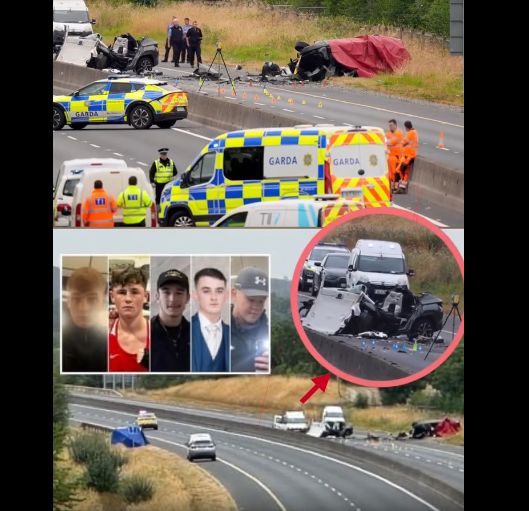
The quiet of a Sunday morning in County Kildare was shattered by a tragedy that has since gripped the nation. In the early hours, a BMW carrying five teenage boys was driven the wrong way down the M9 motorway, colliding head-on with a car carrying three sisters and a seven-year-old boy . The impact was catastrophic; all five teenagers were killed instantly, while the four occupants of the other car were rushed to the hospital with life-threatening injuries . What might have been a simple, devastating road accident has instead opened a window onto a deeply troubling subculture, sparking a wave of public outrage.
The victims, aged between 14 and 18, were not merely joyriding; they were alleged members of a notorious criminal group known as the “Lucky Dip” gang, a network of juveniles notorious for car theft and dangerous driving . As the details emerged, a more chilling picture came into focus. It quickly became apparent that this was not a random act of recklessness. The teenagers had been involved in a string of burglaries and car thefts in the hours before the crash, and police had even attempted to stop them earlier . However, the pursuit was called off due to a critical lack of training for high-speed chases .
The tragedy has sparked a wave of anger and a demand for answers . The public fury is fueled by the discovery that the teenagers had reportedly been documenting their criminal exploits on social media. Videos of them driving dangerously, taunting police, and even driving the wrong way on highways were circulated online, amassing significant attention and likes . This behaviour highlights a toxic cycle where dangerous stunts are performed for social media clout, leading to an escalation in risk-taking . Ireland’s media regulator, Coimisiún na Meán, has since demanded that TikTok explain how such content is being moderated on its platform .
The crash has also exposed critical vulnerabilities in the justice system. The Garda Representative Association confirmed that no officer in the country is fully trained for high-speed pursuits, a gap that left police powerless to intervene safely . Furthermore, a belief that young offenders are beyond consequences due to leniency under Ireland’s juvenile justice system has become a point of intense public debate . Calls for systemic change are growing, with the government now announcing that officers will receive dedicated pursuit training and new legislation is being planned to address the issue .
As the nation reels from the shock, public sympathy for the deceased teenagers is notably scarce. Instead, there is immense grief for the innocent family whose lives were shattered in an instant, along with a widespread feeling that this horrifying incident represents a societal failure that demands urgent and significant reform .