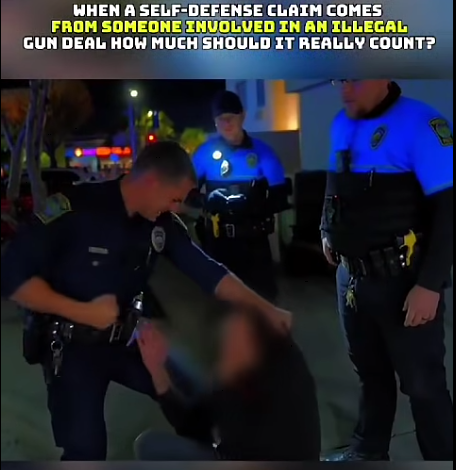
The courtroom falls silent as the defendant takes the stand. They admit to being present at an illegal gun deal. They admit to carrying a weapon without a license. But they insist that when they pulled the trigger, they were acting in self-defense. The question that now confronts the jury, the judge, and the legal system itself is a moral and legal minefield: when a self-defense claim comes from someone involved in an illegal gun deal, how much should it really count?
At first glance, the answer seems simple. The law, in its purest form, does not discriminate based on character when it comes to the right to defend one’s life. The doctrine of self-defense rests on a foundational principle: a person has the right to use reasonable force to protect themselves from imminent death or great bodily harm. This right is not supposed to be contingent on whether the person is a saint or a sinner. If someone is actively being attacked and fears for their life, the law recognizes their right to fight back, regardless of their past mistakes or the illegality of their current circumstances. In theory, a felon facing a knife attack has the same right to self-defense as a nun facing the same threat.
However, theory and reality rarely align so neatly. The context of the illegal gun deal fundamentally alters the moral and legal calculus. When a person willingly participates in an underground firearms transaction, they are not an innocent bystander suddenly caught in a violent storm. They have deliberately placed themselves in a high-risk environment where violence is not just possible but statistically probable. Illegal gun deals are inherently dangerous. They attract people willing to break the law, often people with criminal records, desperate motives, and easy access to weapons. By choosing to enter that world, the defendant has arguably forfeited the clean hands required to make a pure self-defense claim.
This is where the legal concept of “provocation” or “fault” enters the conversation. Many jurisdictions recognize that a defendant who initiates a confrontation or creates the dangerous situation cannot later claim self-defense when that situation turns deadly. If the illegal gun deal itself was the catalyst for the violence—if the defendant’s own criminal choices brought them face to face with an attacker—then their self-defense claim is severely weakened. The law asks: did you create the very peril from which you now seek protection? If the answer is yes, your claim loses much of its moral and legal weight.
Yet we must be careful not to paint with too broad a brush. Not every illegal gun deal ends in a shootout. Not every participant is a hardened criminal. Some are desperate, some are coerced, some are simply foolish. And most importantly, the fact that a person is a criminal does not mean they deserve to die. The right to life is not conditional on good behavior. If the other party in that deal suddenly produces a weapon and tries to murder the defendant, the defendant’s illegal status does not make their bullet any less defensive. They are still a human being fighting for survival.
But the credibility of their claim will inevitably be scrutinized through the lens of their choices. Juries are human. They struggle to sympathize with someone who chose to swim in shark-infested waters and then cries for help when they get bitten. The defendant’s testimony becomes suspect. Their character becomes a liability. The illegal gun deal becomes the lens through which every action is judged. The question shifts from “was this self-defense?” to “does this person deserve the benefit of the doubt?” And for many jurors, the answer is no.
In the end, a self-defense claim from someone involved in an illegal gun deal should count, but only with heavy scrutiny. It should not be dismissed out of hand, because everyone deserves the right to defend their life. But it should be examined with a skeptical eye, because the defendant’s own actions created the very danger they now claim to have merely reacted to. The law may be blind, but justice is not. And justice demands that those who create chaos cannot expect the system to treat them as innocent victims when that chaos turns deadly.