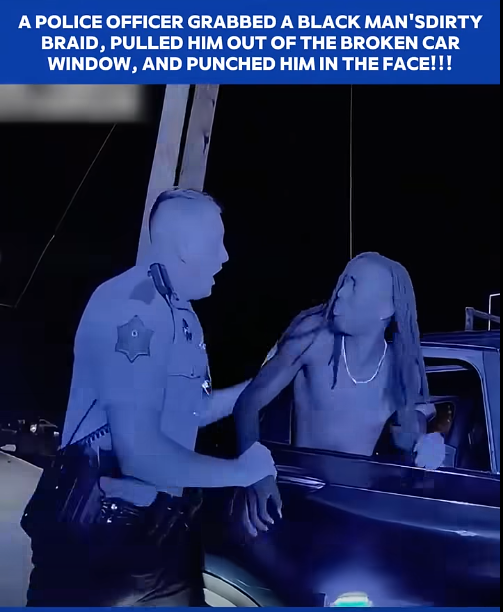
is not just a description; it is a flashpoint. It captures a moment that has become tragically familiar in the American consciousness—a moment that forces us to confront the volatile intersection of law enforcement, race, and the use of force. This single, violent tableau is a broken window in itself, offering a glimpse into a much larger crisis of trust shattering between communities and the police who are sworn to protect them.
The details matter. The officer’s choice to grab the man by his hair, specifically described as a “dirty braid,” dehumanizes the individual. It reduces a person to a physical object to be manhandled. This is not a technique taught in de-escalation training; it is an act of domination. The subsequent action of pulling him through a broken window—a jagged, dangerous aperture—exponentially increases the risk of serious injury. It speaks to a reckless disregard for the suspect’s safety, prioritizing the officer’s immediate desire to extract him over any standard protocol for a traffic stop or arrest. Finally, the punch to the face is the exclamation point on a series of escalating, unnecessary actions. It is a punitive measure delivered when the suspect was already incapacitated, vulnerable, and at the mercy of the officer.
When we analyze this sequence of events—the grab, the pull, the punch—we see the exact opposite of constitutional policing. The Fourth Amendment protects citizens from unreasonable seizures. The force used must be objectively reasonable in light of the totality of the circumstances. A broken car window might suggest a volatile situation, but it does not automatically justify a violent extraction and a strike to the head. Officers are trained to use a continuum of force, starting with verbal commands and escalating only as necessary. This incident appears to have skipped several critical steps, leaping directly to physical domination. This is the kind of excessive force that not only physically harms an individual but also sends a chilling message to the entire community: your safety is not guaranteed, and the law is a weapon to be wielded against you, not a shield for your protection.
The racial dimension of this event is inescapable and underscores a systemic failure. The specific targeting and violent handling of a Black man fit a pattern of disproportionate use of force against African Americans documented by researchers and data analysts for decades. This is not about the actions of a “few bad apples” but about a pervasive culture and systemic biases that can lead to a quicker escalation of violence when the suspect is Black. For communities of color, this incident is not an anomaly; it is data confirming a lived experience of fear, suspicion, and unequal treatment. It reinforces a dangerous narrative where a traffic stop can feel like a death sentence.
The consequence of such actions extends far beyond the physical injuries of the individual. The “broken window” in this context is the fracture of the social contract between the police and the public. When a community witnesses or hears of an officer grabbing a man by his dirty braid and punching him in the face, the trust required for effective policing evaporates. It becomes infinitely harder for other officers to build relationships, gather intelligence, and de-escalate conflicts when the population views them with deep-seated suspicion.
To begin repairing this shattered trust, we must demand transparency, accountability, and a fundamental re-evaluation of what constitutes reasonable force. Body cameras are crucial, but they are not a cure-all; they must be paired with independent investigations and a culture that penalizes, rather than protects, misconduct. Ultimately, healing this crisis requires a shift from a warrior mindset to a guardian one, where an officer’s primary duty is to protect life and dignity for every citizen, regardless of the texture of their hair or the color of their skin. Until that happens, the image of the broken window will remain a symbol of a system in desperate need of repair.