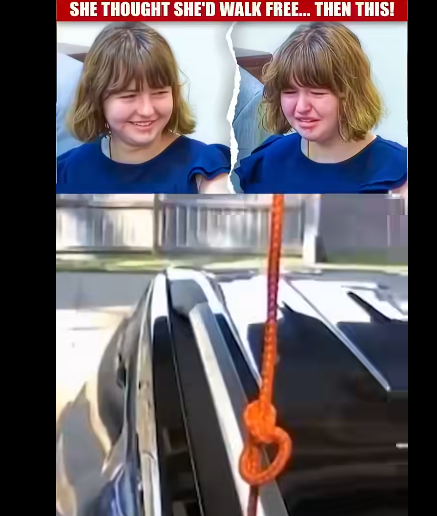
The courtroom atmosphere was deceptively calm. A teenage defendant sat at the defense table, a faint smirk playing on her lips. She had been through the motions of the legal process before, and in her mind, this hearing was just another obstacle—one she was confident she would overcome. She was young, and surely the system would show leniency. The judge was reviewing documents, the prosecutor was shuffling papers, and the teen’s smile widened, convinced she would soon be walking free. She had miscalculated.
The confidence displayed by young defendants in court is not uncommon. In a Florida case, two teenage girls appeared before a judge after being charged in a disturbing murder plot. Fifteen-year-old Isabelle Valdez and fourteen-year-old Lois Lippert had been recorded laughing and joking on their way to jail, treating their arrest as a “bonding experience” and expressing excitement about the situation . Similarly, Carly Gregg, a fifteen-year-old from Mississippi accused of fatally shooting her own mother, was caught on Court TV footage attempting to stifle a laugh during her trial proceedings . The pattern is chilling—a disconnect between the gravity of the accusations and the casual behavior of the accused.
What these teens fail to realize is that the courtroom is not a stage for their performance. The judge has seen the evidence. The prosecutor has prepared the case. And somewhere, likely in the hands of the prosecution, is a piece of footage that will shatter their carefully constructed confidence.
When the prosecutor announced that the state would be playing a video exhibit, the teen’s smile didn’t waver. She leaned back in her chair, perhaps expecting a brief clip that would be easily explained away. Then the lights dimmed, and the screen flickered to life.
The video played in stark, unforgiving detail. It showed exactly what she had done.
The transformation was immediate. Her smirk vanished, replaced by wide-eyed shock. The confident posture crumbled. In a similar case, when a courtroom video was played showing Jahara Malik, eighteen, with her boyfriend moments before she stabbed him, the victim’s family became visibly upset, with some leaving in tears . The video didn’t lie. It showed Malik and the victim running around a stairwell before the victim appeared on the ground, bleeding from his chest. The prosecution argued that the force required to drive a knife through clothing, muscle, and bone into a heart was no accident .
The courtroom fell silent. Families of the victim stared at the screen, their grief and anger palpable. The teen’s defense attorney may have whispered something, but it was too late. The video had already done its damage.
For the judge, the footage was decisive. In the Florida case cited earlier, the judge denied bond for the two teenage girls, ruling that the video demonstrated they posed a danger to the community . The laughter and lack of remorse were not just evidence of guilt—they were evidence of character. The judge concluded that releasing either girl would be too risky .
The teen in our scenario likely faced a similar fate. The plea for leniency, the tears, the excuses—none of it mattered. The video didn’t show a child who made a mistake; it showed a person who made choices, choices that had serious and sometimes fatal consequences. As one prosecutor stated in a separate case, “An accident is something without foresight… And this case screams foreseeability” . The video removed any doubt.
The judge sentenced her not as the child she pretended to be, but as the person the video revealed her to be. The sentences are often severe. In one recent case, eighteen-year-old Jahara Malik received seventeen years in prison for manslaughter . In another, nineteen-year-old Karmelo Anthony was sentenced to thirty-five years for a fatal stabbing . These are not slaps on the wrist; they are life-altering consequences.
As the teen was led away in handcuffs, the courtroom slowly emptied. The victim’s family embraced, their long pursuit of justice finally reaching some form of closure. The teen’s family was left to grapple with the reality of what their loved one had done. The legal process had run its course, and the evidence—that damning video—had spoken the final truth. The smirk was gone, replaced by the grim reality of a future behind bars.