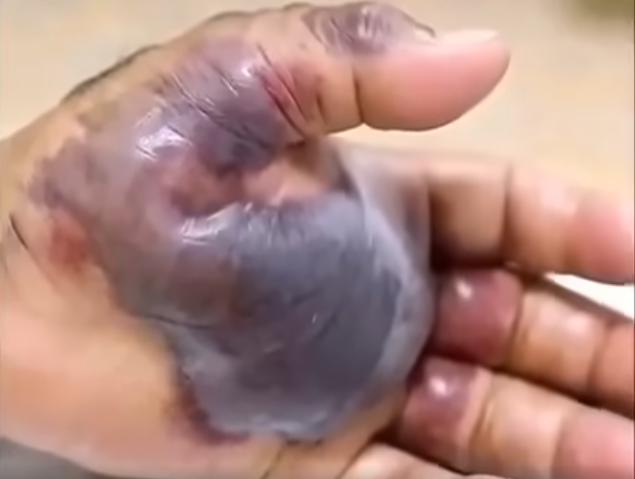
A large blood blister on the hand is a raised pocket of skin filled with blood caused by injury that breaks tiny blood vessels without breaking the skin. It appears red, purple, or black and can cause pain or discomfort. These blisters usually heal on their own within a week.
Finding a large, dark bubble rising from the skin of your hand can be an alarming experience. One moment you are gripping a tool, shutting a drawer, or scraping against a rough surface, and the next, you are staring at a raised pocket of fluid that is rapidly turning a deep shade of red or purple. This is a blood blister, and while it looks dramatic, it is actually your body’s way of initiating a highly efficient emergency repair system.
A blood blister is distinct from the common friction blister you might get from new shoes. While a standard blister fills with clear serum, a blood blister indicates that the trauma was significant enough to rupture tiny blood vessels—capillaries—located just beneath the outer layer of skin. However, the skin itself remains intact. Because there is no open wound, the blood has nowhere to escape. Instead, it pools in the space between the skin layers, creating that characteristic raised pocket. The color of the blister offers a real-time glimpse into the healing process; fresh blood gives it a bright red hue, but as the blood ages and deoxygenates, the blister darkens to a deep purple or even a striking black, much like a severe bruise.
The hand is particularly susceptible to these injuries. Our hands are our primary tools for interacting with the physical world, constantly subjected to pinching, crushing, and shearing forces. Whether it is the heavy impact of a hammer, the pinch of a closing door, or the repetitive friction of a garden tool, the delicate network of blood vessels in the hand is often vulnerable. When a large blood blister forms, it is often accompanied by a throbbing pain or a sensation of tightness. This discomfort is caused by the pressure of the accumulated blood pushing against the sensitive nerve endings in the dermis below. Simple tasks like gripping an object or making a fist can become momentarily challenging due to this tension.
Despite its concerning appearance and the initial sting of pain, the good news for anyone suffering from this injury is that the human body is remarkably adept at handling it. In the vast majority of cases, a blood blister is a self-resolving issue. Over the following days, the body gets to work. The trapped blood is broken down and reabsorbed by the surrounding tissues, much like a bruise fading. Simultaneously, a new layer of skin forms beneath the blister, and the old, damaged top layer will eventually dry out, flatten, and peel away harmlessly. Typically, this entire cycle takes about a week, though larger blisters may take up to ten days to fully disappear.
The most critical piece of advice regarding a blood blister is often the hardest to follow: leave it alone. The urge to pop it can be overwhelming, as many believe releasing the pressure will speed up relief. However, the unbroken skin acts as a natural, sterile bandage, protecting the sensitive wound beneath from bacteria. Popping the blister creates an open wound, drastically increasing the risk of infection, which can turn a minor injury into a serious medical concern.
Unless the blister is exceptionally large, causing unbearable pressure, or shows signs of infection (such as increased redness, warmth, or streaking), the best treatment is simply to cover it with a loose bandage for protection and wait for nature to take its course. If the blister does break on its own, gently wash the area with mild soap and water, apply an antibiotic ointment, and cover it with a sterile dressing. Ultimately, while a large blood blister may be an unsightly and painful nuisance, it is a testament to the body’s incredible ability to heal itself, requiring only a little patience and self-control to resolve perfectly within a week.